 how-to
How to Troubleshoot No Hot Water Electric Heater
Table of Contents
- Safety First: What You Need Before Troubleshooting
- Check the Circuit Breaker and Electrical Supply
- Find and Test the Electric Water Heater Reset Button Location
- How to Test Water Heater Heating Element With Multimeter
- Inspect the Thermostat Settings and Connections
- Signs of a Failing Water Heater and When to Replace
- When to Call a Professional Plumber
- Frequently Asked Questions
Last Updated: September 19, 2026
Safety First: What You Need Before Troubleshooting
Before you touch anything on your water heater, gather the right safety gear. Working with electrical equipment can be dangerous if you're not prepared.
Turn off power at the circuit breaker and wait a few minutes for the system to drain.
Always test with a voltage tester to confirm no current is running through the electrical connections, this prevents serious injury or death.
If you're uncomfortable working with electrical systems at any point, stop and call a licensed professional. Rich's Plumbing Heating & Air Conditioning offers emergency service with a 60-minute response time for your urgent needs.
Check the Circuit Breaker and Electrical Supply
The circuit breaker is often the culprit when you have no hot water, it trips when it detects a problem.
Locate the breaker labeled "water heater." If it's in the middle or OFF position, that's your problem.
Flip the breaker OFF, wait 10 seconds, then flip it back ON. If it stays ON and hot water returns, the problem is solved.
If the breaker trips again immediately, there's an electrical fault inside the heater requiring professional help.
Check the breaker box for burn marks, melted plastic, or a burning smell. If present, call a professional immediately, do not attempt repairs.
Find and Test the Electric Water Heater Reset Button Location
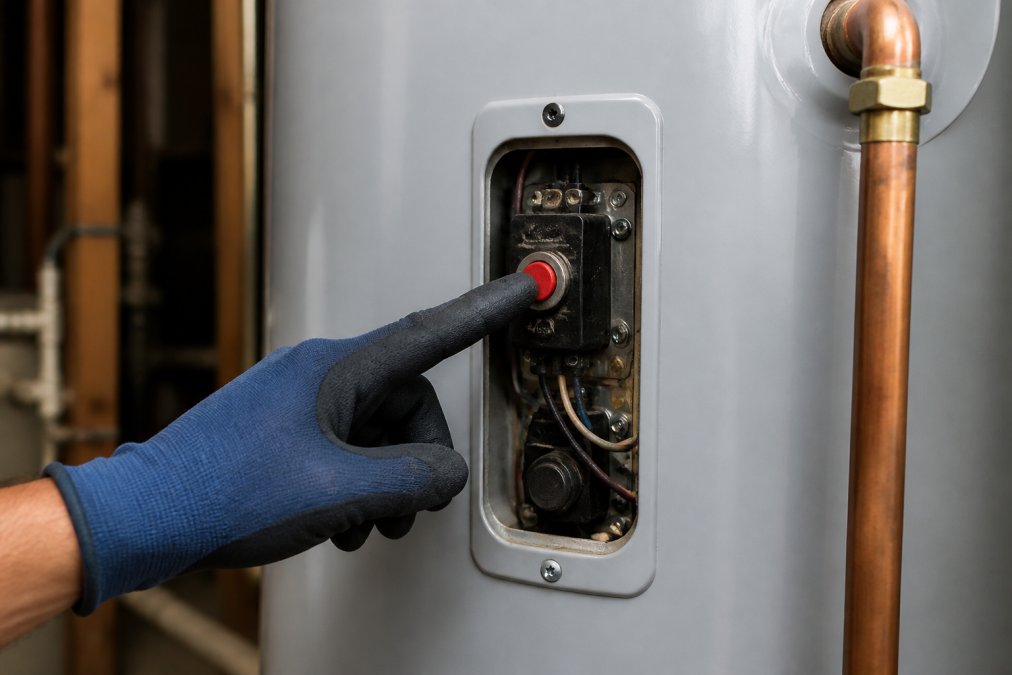
Every electric water heater has a red high-limit reset button that shuts off power when water gets too hot.
The reset button is usually mounted on or near the upper thermostat. If you can't find it, check your heater's manual.
Press the reset button firmly until you hear a click. Leave the breaker OFF for a few minutes, then turn it back ON.
Wait 30 to 45 minutes and check if hot water returns. If it does, the reset button cleared the problem.
If the reset button doesn't work or trips again within a few days, the thermostat is likely failing and needs replacement.
How to Test Water Heater Heating Element With Multimeter
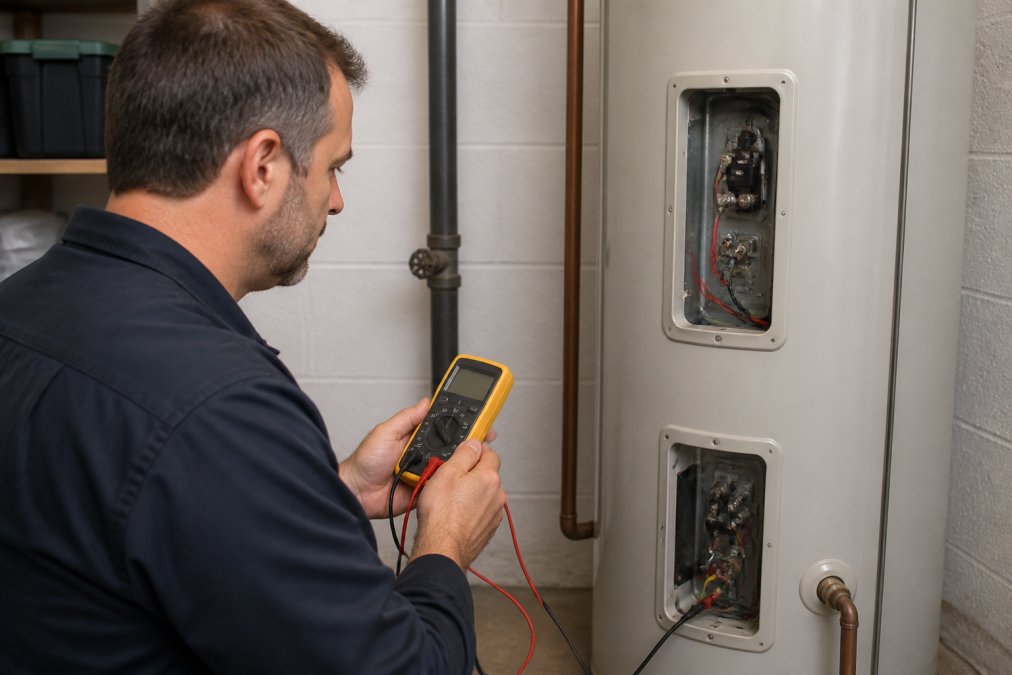
Testing the heating element with a multimeter tells you if it's working or dead. This is how to troubleshoot no hot water electric heater at the component level.
Before You Start
Turn off power at the breaker and wait at least two minutes. Use your voltage tester on the heating element terminals to confirm no power is present. Do not proceed if the tester lights up or beeps.
Locating the Heating Elements
Most electric water heaters have two heating elements (upper and lower) mounted inside the tank and accessed through metal flanges on the side.
Locate the upper element, typically 12 to 24 inches from the top. You'll see a metal flange with bolts or screws. Remove the access panel or insulation blanket if present.
What a Failed Element Looks Like
A working element is a shiny or slightly tarnished coiled metal tube. A failed element shows burn marks, corrosion (greenish, white, or crusty), visible cracks, dark discoloration, or thick mineral buildup. Visual damage indicates replacement need.
Setting Up Your Multimeter
Set your multimeter to the ohms (Ω) setting, starting with 200Ω range. Most residential elements fall between 10 and 30 ohms. Continuity mode (marked with a sound-wave symbol) also works for this test.
Testing the Element
Locate the two terminals (usually brass or copper bolts) on the heating element. Touch one multimeter probe to each terminal, holding steady for 3 to 5 seconds. Do not let the probes touch each other or any other metal part.
Read the display: 10-30 ohms = working element; 0 ohms = short circuit (replace); infinity/OL = broken (replace); above 50 ohms = degraded (replace if heater is over 8 years old).
If You Get an Ambiguous Reading
If your reading is between 30 and 50 ohms, test the lower element as well. High resistance on both suggests sediment buildup; on one element in a heater over 10 years old, replacement is safer. Test your meter on a known working device to confirm accuracy.
What to Do After Testing
If the element tests bad, replacement is necessary. If the element tests good but you still have no hot water, test the thermostat or check for sediment buildup.
Inspect the Thermostat Settings and Connections
The thermostat controls when the heating element turns on and off. If it's set wrong or broken, you get no hot water even if the element works.
Check the temperature dial, it should be set between 120 and 140 degrees Fahrenheit. If it's too low or on a vacation setting, adjust it to 120 degrees and wait a few hours.
Inspect the thermostat wires for loose, corroded, or disconnected connections. Loose wires prevent the thermostat from signaling the heating element.
Tighten loose connections. If wires are corroded (greenish or crusty), clean them gently with a brush or sandpaper and reconnect firmly.
Test the thermostat with your multimeter in continuity mode. A beep or reading means it's working; no beep means it's bad.
If testing shows the thermostat is broken, replacement is necessary.
Signs of a Failing Water Heater and When to Replace
Some signs point to replacement as the only real fix. Use a decision framework based on your heater's age and repair costs to decide whether to repair or replace.
Age-Based Decision Framework
Water heaters last 8 to 12 years on average. Use this framework to decide repair vs. replacement:
0-5 years old: Repair almost always makes sense. A single failed element or thermostat ($50-$300 parts, $150-$400 labor) is much cheaper than a new heater ($1,200-$2,500 installed).
6-8 years old: Repair is still better unless multiple components fail. A single repair costs $300-$600 and buys 2-4 more years. Consider replacement if the tank leaks or the anode rod has failed.
9-12 years old: Get a professional inspection.
Visual and Performance Warning Signs
The Repeated Reset Problem
The Cost Comparison Checklist
Before you decide, gather this information:
- Heater age: Check the manufacture date on the label (usually on the side or back of the tank).
- Repair estimate: Call a licensed plumber and get a written estimate for the repair.
- Replacement cost: Ask the plumber for a quote on a new heater (typically $1,200-$2,500 installed, depending on capacity and efficiency).
- Expected remaining life: Ask the plumber how many more years they expect the heater to last if repaired.
A professional water heater inspection can tell you whether repair or replacement makes sense for your specific situation. A licensed plumber will assess your heater's condition, estimate its remaining life, and give you honest guidance on the most cost-effective path forward.
When to Call a Professional Plumber
Some problems are beyond DIY troubleshooting. Know when to stop and call an expert.
Frequently Asked Questions
What is the first thing I should check if I have no hot water?
Start by checking your electrical panel for a tripped circuit breaker dedicated to the water heater. Look for any breaker switch in the OFF position and flip it back to ON. If it trips again immediately, stop and call a professional, this indicates a serious electrical fault. Next, locate the high-limit reset button on your water heater tank (usually a red button on the thermostat) and press it once. Many no-hot-water situations resolve with these two simple checks.
How do I know if my water heater heating element is bad?
A failing heating element typically produces no hot water even after the tank has had time to heat. To confirm, use a multimeter set to the ohms (resistance) setting and test the element's terminals. A healthy element reads between 12-30 ohms; a reading of zero or infinity indicates failure. You may also notice sediment buildup around the element or visible corrosion on the terminal connections. If the element is bad, replacement is necessary.
Where is the reset button on an electric water heater?
The high-limit reset button is typically located on the upper thermostat of your electric water heater, usually mounted on the side of the tank beneath the insulation cover. It appears as a small red or black button. Before pressing it, turn off the breaker to the heater for safety. Press the button firmly once, you may hear or feel a click. Wait a few minutes, then restore power and check if hot water returns. Never press it repeatedly; one firm press is sufficient.
Is it dangerous to troubleshoot an electric water heater myself?
Electric water heaters carry real hazards: live electrical current, high water temperatures (120°F+), and pressurized tanks. Always turn off the breaker before inspecting internal components or using a multimeter. Never remove the access panel or thermostat covers while power is on. Wear safety glasses and avoid touching metal parts unnecessarily. If you're uncomfortable working with electrical systems, sediment buildup, or suspect wiring damage, stop and contact a licensed plumber. Professional diagnosis costs far less than treating an electrical injury.
A water heater that won't produce hot water is frustrating, but most problems have straightforward fixes. Start with the circuit breaker and reset button. Test components with a multimeter if you're comfortable. But if you hit a wall or feel unsafe, that's when to call Rich's Plumbing Heating & Air Conditioning. Our team specializes in electric water heater troubleshooting and repair. We guarantee your satisfaction and stand behind every job. Tap to easily schedule service today.