 ultimate-guide
Average Cost to Replace HVAC: 2026 Guide
Table of Contents
- What Drives the Average Cost to Replace HVAC Systems
- Labor, Permits, and Hidden Costs of HVAC Installation
- HVAC System Sizing Guide: Tonnage, BTUs, and Square Footage
- HVAC Repair vs Replacement Cost: How to Decide
- HVAC Tax Credits and Rebates 2025: What New Jersey Homeowners Can Claim
- How to Compare HVAC Replacement Quotes the Right Way
- Replace HVAC With Confidence: Next Steps for NJ Homeowners
- Frequently Asked Questions
Last Updated: August 9, 2026
What Drives the Average Cost to Replace HVAC Systems
Replacing an HVAC system is one of the largest home improvement investments a New Jersey homeowner will make. The average cost varies significantly based on system type, home size, efficiency ratings, and installation complexity. This guide breaks down every variable that moves that number up or down, so you can walk into any quote conversation with clarity.
The biggest mistake homeowners make is treating HVAC replacement like buying an appliance off a shelf. Equipment cost is only part of the picture. Labor, permits, ductwork condition, and efficiency tier all play a role.
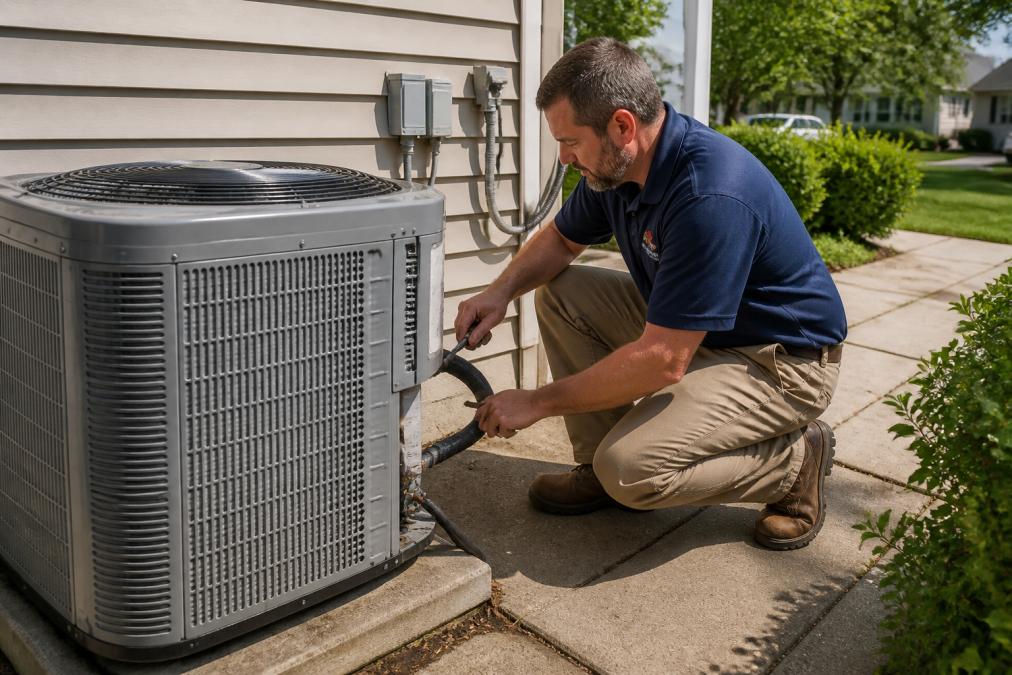
System Type: Furnace, Central AC, or Heat Pump
The type of system you're replacing is the single largest driver of total project cost.
Central air conditioning handles cooling only, involving an outdoor condenser unit and an indoor air handler or evaporator coil. Because it addresses only one half of your home's comfort needs, it typically carries a lower total project cost than a full system swap.
Furnace replacement covers heating only, typically gas-fired in most NJ homes. Costs vary based on AFUE efficiency rating, fuel type, and whether existing ductwork and flue configuration are compatible with the new unit.
Heat pumps handle both heating and cooling from a single system. They've grown significantly in popularity across New Jersey because of their efficiency advantages and eligibility for federal tax credits. Cold-climate heat pumps now perform reliably well below freezing, addressing concerns many NJ homeowners have about winter performance.
| System Type | Function | Best For | Key Cost Driver |
|---|---|---|---|
| Central AC | Cooling only | Homes with existing heat source | Tonnage and SEER2 rating |
| Gas Furnace | Heating only | Homes with existing AC | AFUE rating and BTU output |
| Heat Pump (standard) | Heating + cooling | Mild-climate zones | Equipment and installation complexity |
| Cold-climate heat pump | Heating + cooling | NJ winters | Higher equipment cost, rebate-eligible |
| Dual-fuel system | Heating + cooling | Extreme climate backup | Two-system installation cost |
SEER2 and AFUE Ratings: How Efficiency Affects Price
Efficiency ratings directly affect both purchase price and long-term operating costs.
SEER2 is the current efficiency standard for air conditioners and heat pumps, replacing the older SEER metric as of January 2023. As required by the U.S. Department of Energy minimum efficiency standards, new central AC and heat pump systems installed in the Northern region (which includes New Jersey) must meet a minimum SEER2 rating of 13.4 for split systems. Higher SEER2 ratings mean better energy efficiency and lower monthly utility bills, but also higher equipment costs. A system rated at 18 SEER2 or above will cost more than a minimum-compliant 13.4 SEER2 unit.
AFUE measures furnace efficiency. A 96% AFUE furnace converts 96 cents of every dollar of gas into usable heat. Standard-efficiency furnaces run around 80% AFUE, while high-efficiency condensing furnaces reach 96-98% AFUE. The energy savings in a cold NJ winter often justify the equipment cost difference over a 10-15 year system lifespan.
Labor, Permits, and Hidden Costs of HVAC Installation
Most quotes focus on equipment. The real surprises show up in line items that don't make it into the headline number.
Labor costs for HVAC installation in New Jersey vary based on job complexity, system type, and contractor experience. A straightforward swap-out with compatible ductwork takes less time than a full system change involving new equipment configuration or fuel type conversion. Expect labor to represent a significant portion of your total project cost.
Permit fees are non-negotiable in New Jersey. Most HVAC replacement work requires a mechanical permit from your local municipality. Any licensed contractor operating correctly will pull permits as part of the job. If a contractor offers to skip permits to save money, walk away.
Hidden costs to budget for:
- Refrigerant: Older systems using R-22 require replacement because R-22 is no longer manufactured. New systems use R-410A or R-454B.
- Disconnect and disposal: Removing and disposing of old equipment carries a cost.
- Electrical upgrades: Heat pumps sometimes require a dedicated circuit or panel upgrade.
- Thermostat replacement: A smart thermostat is often recommended for compatibility and efficiency.
- Condensate drainage: New high-efficiency systems produce condensate requiring proper drainage.
Ductwork, Air Handlers, and Add-On Equipment
Ductwork condition is the hidden variable most homeowners underestimate. A new, high-efficiency system installed on a leaky duct system will never perform to spec. According to the U.S. Department of Energy's guidance on duct efficiency, duct leakage in a typical home can account for more than 30% of heating and cooling energy loss.
If your ductwork is more than 20 years old, has never been inspected, or was sized for a different system, a duct assessment should be part of any replacement conversation. Duct sealing, partial replacement, or full duct replacement each carry different costs.
Air handlers in split systems circulate conditioned air through ductwork. When replacing a central AC or heat pump, the air handler often needs replacement alongside the outdoor unit to ensure compatibility and maintain warranty.
Add-on equipment commonly appearing in quotes includes whole-home dehumidifiers, UV air purification systems, zoning controls, and smart thermostats. Evaluate each based on your specific comfort complaints and budget.
HVAC System Sizing Guide: Tonnage, BTUs, and Square Footage
Correct system sizing is more important than equipment brand or efficiency rating. An undersized system runs constantly and never achieves target temperature. An oversized system short-cycles, creating humidity problems and premature component wear.
HVAC capacity is measured in tons (for cooling) and BTUs (for heating). One ton of cooling equals 12,000 BTUs per hour. Residential systems typically range from 1.5 to 5 tons for cooling.
A proper sizing calculation, called a Manual J load calculation, accounts for home square footage, ceiling height, windows and orientation, insulation levels, local climate data, occupants, and ductwork configuration. A rough rule of thumb suggests approximately 1 ton of cooling per 600 square feet, but this is a starting point, not a specification.
The [Air Conditioning(/hvac-services/air-conditioning-repair/) Contractors of America Manual J residential load calculation standard | acca.org] is the industry standard for sizing. Any reputable HVAC contractor should perform or reference this calculation when recommending system capacity.
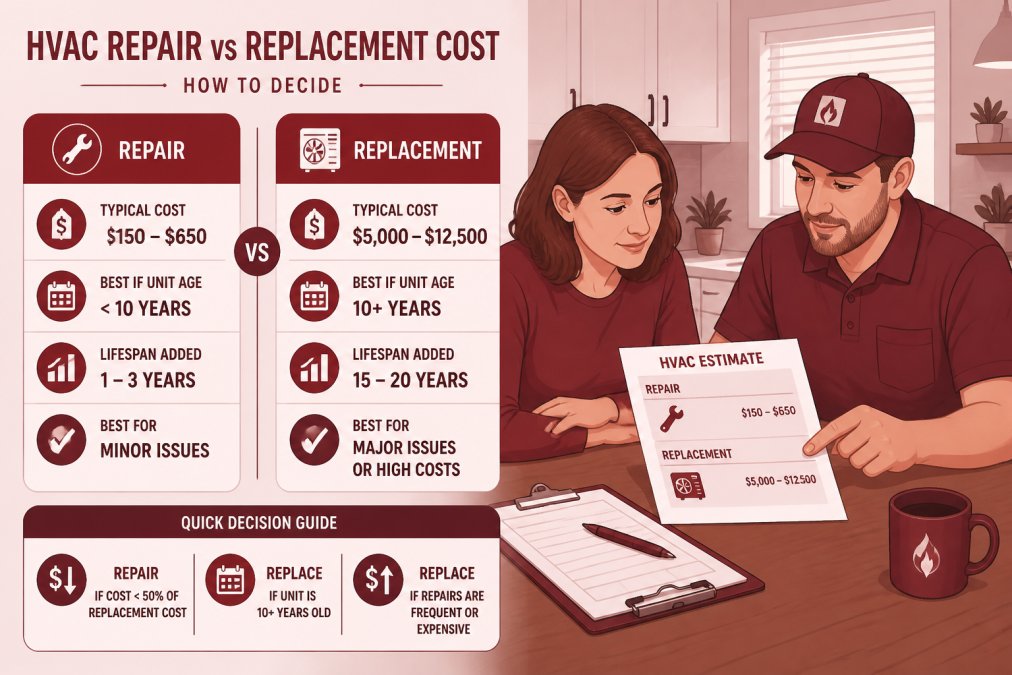
HVAC Repair vs Replacement Cost: How to Decide
The most practical tool for this decision is the $5,000 Rule: multiply the age of the system (in years) by the cost of the repair. If the result exceeds $5,000, replacement is generally the more economical choice.
| System Age | Repair Cost | Rule Result | Recommendation |
|---|---|---|---|
| 8 years | $400 | $3,200 | Repair |
| 12 years | $600 | $7,200 | Replace |
| 15 years | $300 | $4,500 | Repair (borderline) |
| 10 years | $550 | $5,500 | Replace |
Lean toward replacement when:
- The system is more than 15 years old (average HVAC system lifespan is 15-20 years)
- The compressor or heat exchanger has failed
- The system uses R-22 refrigerant (no longer manufactured)
- Energy bills have been climbing without explanation
- The system requires frequent repairs over the past two years
Lean toward repair when:
- The system is under 10 years old
- The repair is minor (capacitor, contactor, thermostat)
- The system has been well-maintained with no history of repeated failures
- You are planning to sell within 12-18 months
HVAC Tax Credits and Rebates 2025: What New Jersey Homeowners Can Claim
Tax credits and rebates meaningfully reduce the net cost of a qualifying HVAC replacement.
Federal Tax Credits (IRA Section 25C)
The Inflation Reduction Act extended and expanded federal tax credits for energy-efficient home improvements. Homeowners who replace HVAC equipment with qualifying high-efficiency systems can claim a federal tax credit of up to 30% of the equipment cost. As detailed by the ENERGY STAR federal tax credit guidance for homeowners, qualifying equipment includes central air conditioners, gas furnaces, heat pumps, and air handlers meeting specific efficiency requirements.
New Jersey State Rebates
New Jersey homeowners have access to rebate programs through New Jersey's Clean Energy Program. Rebates are available for qualifying heat pumps, high-efficiency furnaces, and central AC systems. Check current availability with your contractor or through the New Jersey Board of Public Utilities, as program funding changes throughout the year.
Utility Company Rebates
PSE&G and other New Jersey utilities offer rebate programs for qualifying equipment. These can stack with federal credits and state rebates, meaningfully reducing your net out-of-pocket cost.
How to Compare HVAC Replacement Quotes the Right Way
A replacement quote is not just a price, it is a specification document. Two quotes with different numbers may describe completely different scopes of work.
Quote Comparison Checklist
- Is the equipment brand, model number, and efficiency rating (SEER2/AFUE) specified?
- Does the quote include a Manual J load calculation or reference to system sizing methodology?
- Are permit fees included, or listed separately?
- Is ductwork inspection or modification included?
- Are refrigerant handling and old equipment disposal included?
- What is the equipment warranty? (Typically 5-10 years on parts; some extend to 12 years with registration.)
- What is the labor warranty? (Reputable contractors stand behind installation work for at least 1-2 years.)
- Is the contractor licensed in New Jersey?
- Is the contractor pulling permits?
- Are financing options available?
The cheapest quote is rarely the best. A contractor who specifies equipment in detail, pulls permits, performs proper sizing, and backs their labor with a warranty is worth paying more for.
Replace HVAC With Confidence: Next Steps for NJ Homeowners
Replacing HVAC equipment in a New Jersey home involves more decisions than most homeowners expect. System type, efficiency ratings, sizing, ductwork condition, available incentives, and contractor quality all affect whether the project delivers long-term value.
The framework is straightforward: understand what type of system your home needs, get quotes that specify equipment by model number, apply the $5,000 Rule to any repair-vs-replace decision, and ask every contractor about available tax credits and rebates before committing.
Rich's Plumbing Heating & Air Conditioning has served New Jersey homeowners since 1989. The homeowners who feel best about their HVAC investment are the ones who asked the right questions before signing. Whether you're facing an emergency breakdown or planning a proactive replacement, getting a clear, itemized estimate is the first step.
Frequently Asked Questions
What is the $5,000 rule for HVAC?
The $5,000 rule is a quick decision framework: multiply your system's age by the estimated repair cost. If the result exceeds $5,000, replacement is generally the smarter financial move. For example, a 15-year-old system facing a $400 repair scores 6,000, suggesting replacement. It's a rough guide, not a guarantee, but it helps homeowners avoid pouring money into aging equipment that will likely need another costly repair within a year or two.
How much does a new HVAC system cost for a 2,000 sq. ft. house?
For a 2,000 square foot home, you'll typically need a 3- to 4-ton system. Total installed costs vary based on system type (central AC, heat pump, or furnace), efficiency rating, ductwork condition, and local labor rates in New Jersey. Because pricing depends on site conditions, equipment brand, and SEER2 or AFUE ratings chosen, the best approach is to request a free, itemized quote from a licensed HVAC contractor who can assess your home directly.
Does the SEER2 rating affect the cost of a new HVAC system?
Yes, significantly. Higher SEER2-rated systems cost more upfront but reduce monthly energy bills, often paying back the premium within several years. As of January 2023, federal minimum SEER2 standards apply to all new equipment sold in the U.S. Systems with SEER2 ratings above the minimum may also qualify for federal tax credits under the Inflation Reduction Act, making the higher initial cost more manageable for New Jersey homeowners.
What factors influence the total cost of HVAC installation?
The biggest cost drivers are system type (heat pump, furnace, or central AC), system capacity in tons or BTUs matched to your home's square footage, SEER2 or AFUE efficiency rating, ductwork condition or replacement needs, labor rates in your area, permit fees, and any additional equipment like smart thermostats or air handlers. Homes with existing ductwork in good shape cost less to retrofit than those needing new duct runs or a full system overhaul.
Is it worth replacing a 20-year-old AC unit?
Generally, yes. Most central air conditioning systems have a lifespan of 15 to 20 years. A 20-year-old unit operates on outdated refrigerant standards, runs at a fraction of modern SEER2 efficiency levels, and likely faces compressor or refrigerant issues that cost nearly as much to fix as a new system. Replacement also opens the door to federal tax credits and lower energy bills. Apply the $5,000 rule to your specific repair estimate before committing either way.
Choosing the right contractor matters as much as choosing the right equipment. Rich's Plumbing Heating & Air Conditioning brings over 30 years of New Jersey experience, a licensed and insured team, and a 100% satisfaction guarantee to every HVAC installation. Our 60-minute response time means you're not left waiting when your system fails in the middle of a NJ summer or winter. Tap to easily schedule service today and get a free estimate on your HVAC replacement.