 ultimate-guide
AC Repair Cost Estimate Factors: A 2026 Guide
Table of Contents
- What Determines Your AC Repair Cost Estimate
- Common AC Parts That Fail and Their Impact on Pricing
- Average Cost of AC Repair by Component and Labor
- How System Age Affects Your AC Repair Cost Estimate
- HVAC Repair vs Replacement Calculator: When to Replace Your Unit
- How to Get an Accurate HVAC Repair Quote
- Hidden Costs and Payment Options for AC Repairs
- Conclusion
- Frequently Asked Questions
Last Updated: August 28, 2026
What Determines Your AC Repair Cost Estimate
Understanding your AC repair cost estimate requires recognizing that pricing depends on which component failed, your system's age, local labor rates, and whether you need emergency service. At Rich's Plumbing Heating & Air Conditioning, we've helped homeowners understand exactly what to expect before work begins.
Several factors determine your final bill: the specific part needing replacement (capacitor, refrigerant leak repair, or compressor failure), system age, your technician's labor rate, emergency service surcharges, and unit accessibility. A transparent quote breaks down parts, labor hours, diagnostic fees, and service charges separately, letting you make an informed repair-or-replace decision.
Common AC Parts That Fail and Their Impact on Pricing
The parts that fail most often shape the cost landscape. Capacitor failures are among the least expensive repairs, while compressor failures or refrigerant leaks often trigger the "replace vs. repair" conversation.
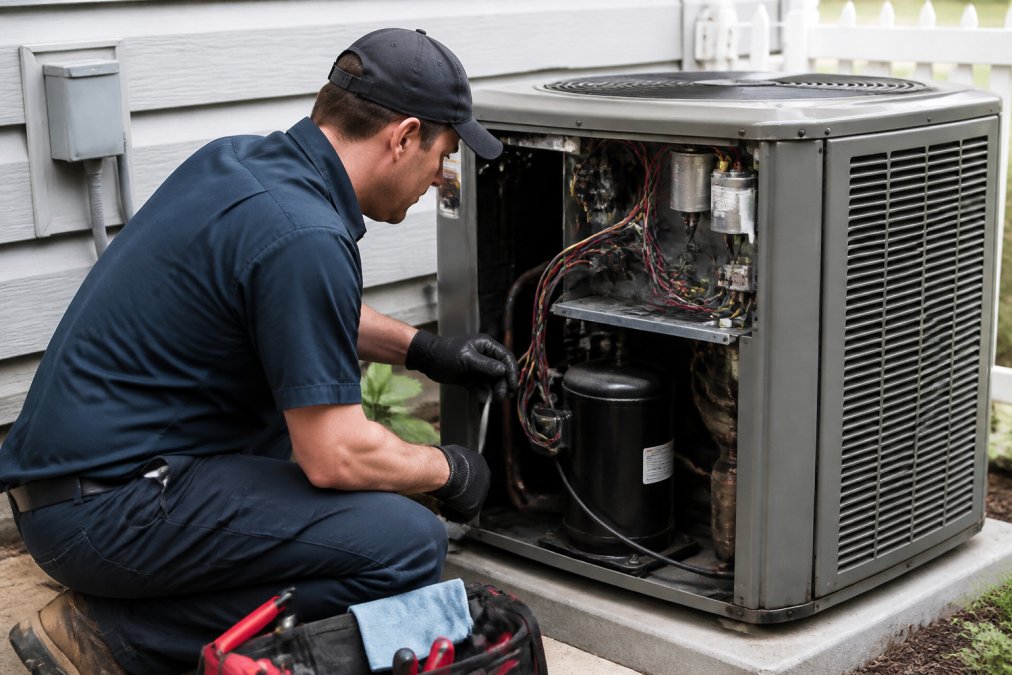
Capacitor replacement keeps your blower motor and compressor running. When it fails, your system won't start or runs intermittently. The part is inexpensive; you're paying for technician time and expertise.
Refrigerant leaks require finding and sealing the leak, then recharging the system. Leak detection can take time if it's small or hard to reach. You pay for the refrigerant charge based on your system's capacity and current prices.
Compressor failure is the costliest common repair. The compressor pressurizes refrigerant and enables cooling. Replacement involves significant labor and a high-cost part. Many technicians recommend replacing the entire unit rather than just the compressor because the economics often favor a new system with warranty.
Evaporator coil leaks fall into a gray zone. Small leaks can be sealed temporarily; larger ones usually mean coil replacement, sitting in the mid-to-high cost range and often prompting the repair-versus-replace decision.
Blower motor failure stops air circulation entirely. Motor replacement is straightforward and moderately priced compared to compressor work.
Thermostat calibration issues sometimes masquerade as system failures. Recalibration or replacement is among the least expensive fixes.
Parts directly affecting cooling capacity (compressor, refrigerant, evaporator coil) cost significantly more than supporting parts (capacitor, blower motor, thermostat). The part name tells you roughly where the cost will fall.
Average Cost of AC Repair by Component and Labor
Labor rates vary significantly by region, company reputation, and experience level. Emergency service calls typically carry a surcharge of 50 to 100 percent over standard rates. Some companies charge a diagnostic fee upfront; others waive it if you proceed with repairs.
Parts costs depend on whether your technician uses OEM (original equipment manufacturer) parts or aftermarket alternatives. OEM parts carry a warranty and guaranteed compatibility; aftermarket parts cost less but may have shorter lifespans.
| Component | Typical Cost Range | Labor Time | Notes |
|---|---|---|---|
| Capacitor Replacement | Low | 0.5-1 hour | Often the least expensive repair |
| Blower Motor | Low to Mid | 1-2 hours | Straightforward replacement |
| Thermostat Recalibration | Low | 0.25-0.5 hour | Quick diagnostic and fix |
| Refrigerant Recharge | Mid | 1-2 hours | Depends on leak detection time |
| Evaporator Coil Repair | Mid to High | 2-4 hours | May require system evacuation |
| Compressor Replacement | High | 3-5 hours | Often triggers replace-vs-repair decision |
Understanding this breakdown helps you evaluate whether a quote is reasonable. If a technician quotes three hours for a capacitor swap, the estimate is inflated.
How System Age Affects Your AC Repair Cost Estimate
Your HVAC system's age determines not just whether repair makes sense, but what you'll pay. A 3-year-old unit and a 15-year-old unit needing the same part will have different repair costs due to parts availability, labor complexity, and likelihood of additional failures.
Newer systems use standardized, readily available parts. Older systems, especially those out of production for five or more years, require special ordering, adding time and cost.
Labor time increases with system age. Technicians work faster on current models; servicing a 20-year-old unit requires consulting documentation and accounting for corrosion or wear, adding 30 to 50 percent more labor time (ashrae.org).
System efficiency degrades over time. A 12-year-old unit isn't cooling as effectively as when new, even if functioning. Repair costs compound this problem: you're spending money to maintain a less efficient system than modern alternatives.
Warranty coverage typically expires after 5 to 10 years. Once out of warranty, you're paying full price for parts and labor with no manufacturer support.
Most HVAC professionals recommend considering replacement when your system is 12 to 15 years old and a major repair (compressor, evaporator coil) is needed. A system 8 to 10 years old with a mid-range repair is usually worth fixing. Anything under 5 years almost always warrants repair.
Multiply the repair cost estimate by the expected remaining lifespan (typically 3 to 5 years for aging units). If that product exceeds 50 percent of replacement cost, replacement often makes financial sense when factoring in energy savings and warranty protection.
HVAC Repair vs Replacement Calculator: When to Replace Your Unit
Deciding whether to repair or replace requires comparing immediate repair cost against replacement cost and long-term savings.
Start with your repair cost estimate and add the likelihood of additional failures in the next 3 to 5 years. A 14-year-old compressor failure often signals other components are aging; you might repair the compressor, only to face an evaporator coil leak within 18 months.
Compare that total to replacement cost. A new HVAC system includes installation (typically 30 to 50 percent of total cost) and comes with a 10-year warranty on parts and 5-year labor coverage (the EPA). You're buying reliability and peace of mind.
Calculate energy savings. Modern systems carry higher SEER ratings (Seasonal Energy Efficiency Ratio), meaning they cool your home using less electricity. A 12-year-old system at SEER 13 versus a new system at SEER 16 translates to 15 to 25 percent lower cooling costs annually (energy.gov). Over 10 years, savings are substantial.
The repair-versus-replace decision framework:
- Repair if: System is under 8 years old, repair cost is under 30 percent of replacement cost, and the failed part is not the compressor or evaporator coil
- Consider replacement if: System is 10 to 14 years old and repair cost exceeds 40 percent of replacement cost
- Replace if: System is 15 years or older, compressor or evaporator coil has failed, or you've had two or more major repairs in three years
How to Get an Accurate HVAC Repair Quote
An accurate HVAC repair quote requires in-home inspection and diagnostics. Transparent companies like Rich's Plumbing Heating & Air Conditioning perform in-home evaluations before quoting.
Tap to easily schedule service today! →
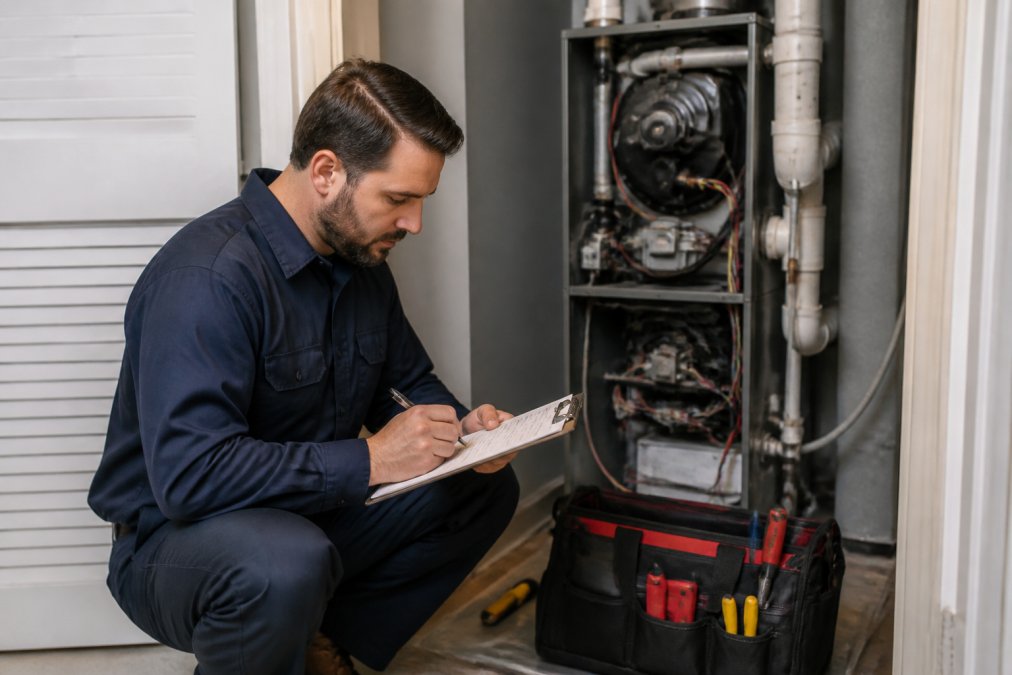
Describe symptoms clearly. "The system won't cool" is vague; "the compressor cycles on and off every few minutes, and the evaporator coil is frozen" is actionable. Detail helps technicians narrow down problems quickly.
Request an in-home evaluation. A technician quoting over the phone without seeing your system is guessing. In-home visits let technicians measure system age, check refrigerant levels, test electrical connections, and assess component accessibility. This typically takes 30 to 60 minutes.
Ask whether the company charges a diagnostic fee and whether it applies to repair costs if you hire them.
Request a written estimate itemizing parts, labor, and service charges separately. Include the part name, whether it's OEM or aftermarket, labor hours, hourly rate, service call fees, and total. This prevents surprises.
Ask about warranty. Most reputable companies warranty labor for one year and parts for the manufacturer's warranty duration (typically 5 to 10 years).
Compare at least two estimates. Different technicians might diagnose the same problem differently. Comparing estimates reveals whether the diagnosis is consistent.
Don't automatically choose the lowest estimate. A significantly lower quote might reflect lower-quality parts or inexperienced labor. The middle estimate, backed by clear explanation, is often safest.
Request references or reviews. Ask how long the company has been in business, whether they're licensed and insured, and whether they can provide customer references. Rich's Plumbing Heating & Air Conditioning has served New Jersey since 1989 with a 100% satisfaction guarantee.
Hidden Costs and Payment Options for AC Repairs
Several costs can surprise homeowners if not anticipated.
Emergency service surcharges are most common. A repair costing $800 during business hours might cost $1,200 at 10 p.m. on Sunday. Emergency calls typically carry a 50 to 100 percent surcharge.
Additional repairs discovered during diagnosis are common. A technician fixing a refrigerant leak might discover the evaporator coil is also corroded. Request that the technician call before proceeding with unexpected repairs.
Permit and inspection costs apply in some jurisdictions when replacing your entire system. These typically add $200 to $500.
Refrigerant disposal fees apply when technicians evacuate and dispose of old refrigerant. Expect $50 to $150 depending on your system's refrigerant volume.
Travel charges are less common but possible if your home is far from the company's service area.
Payment options vary by company. Most accept credit cards, checks, and bank transfers. Some offer financing for replacement projects, spreading costs over 12 to 60 months.
Many homeowners benefit from setting aside $25 to $50 monthly for HVAC maintenance. This covers many mid-range repairs without financial strain and encourages regular maintenance, extending system lifespan.
Conclusion
Understanding your AC repair cost estimate requires knowing which components fail, how system age affects pricing, and what hidden costs might emerge. The repair-versus-replace decision hinges on comparing immediate costs against long-term reliability and energy savings. An accurate quote demands an in-home evaluation, clear itemization, and comparison across at least two technicians.
When you're ready to move forward, Rich's Plumbing Heating & Air Conditioning delivers transparent estimates, fast 60-minute response times, and licensed, insured technicians backed by a 100% satisfaction guarantee. We'll ensure you understand every line item before work begins. Tap to easily schedule service today and get a detailed estimate from professionals who prioritize your comfort and your budget.
Frequently Asked Questions
What is the $5,000 rule for AC repair vs. replacement?
The $5,000 rule is a guideline that helps homeowners decide whether to repair or replace an aging AC unit. The basic formula: multiply the age of your system (in years) by the repair cost. If the result exceeds $5,000, replacement is often more economical long-term. For example, a 10-year-old system with a $600 repair would total $6,000, suggesting replacement. However, this is a starting point, your specific situation depends on the unit's condition, remaining warranty, and energy efficiency gains from a new system.
How much does a new AC unit cost for a 2,000 square foot home?
New AC unit pricing varies significantly based on SEER rating, brand, installation complexity, and local labor rates. Rather than guessing, contact a licensed HVAC contractor for a free estimate tailored to your home's cooling capacity needs and ductwork condition. Rich's Plumbing Heating & Air Conditioning offers free estimates for new installations, this ensures you receive an accurate quote reflecting your specific situation and local market conditions.
Is it worth fixing a 20-year-old AC unit?
A 20-year-old AC system is near or beyond its typical 15-20 year lifespan. Repair makes sense only if the issue is minor (under $500-$800) and the unit has maintained good efficiency. Older systems consume significantly more energy, so even if repair is cheaper upfront, higher monthly utility bills compound costs. Consider the repair cost against replacement savings on energy bills and the reliability risk of an aging unit failing during peak summer demand.
How do labor rates and regional costs affect my AC repair estimate?
Labor rates typically account for 40-60% of total repair costs and vary by region, technician experience, and service urgency. Emergency or same-day service commands premium rates. Urban areas generally have higher labor costs than rural regions. A diagnostic fee (often $75-$150) is standard to identify the problem. Your local market conditions, technician certification level, and whether you choose OEM parts versus aftermarket components all influence final pricing.
What are the most expensive AC parts to replace?
Compressor failure is typically the most costly repair, often ranging from $1,000-$3,000+ including labor, as it requires system evacuation and refrigerant recharge. Evaporator coil replacement runs $1,200-$2,500, and condenser unit replacement ranges from $1,500-$3,000. Capacitor and blower motor replacements are less expensive ($300-$800 total). Parts-and-labor costs depend on whether you use OEM parts or aftermarket alternatives, plus your HVAC contractor's rates.
Why is preventative maintenance important for AC repair costs?
Regular preventative maintenance catches minor issues before they become expensive failures. A well-maintained system runs at peak efficiency, reducing energy consumption and strain on components like the compressor and blower motor. Annual tune-ups, including refrigerant checks, thermostat calibration, and coil cleaning, extend unit lifespan and lower repair frequency. Systems with documented maintenance history also command better resale value and may qualify for extended warranty coverage.
Should I choose OEM parts or aftermarket parts for my AC repair?
OEM (original equipment manufacturer) parts are built to exact specifications and typically carry full warranty coverage, but cost 20-40% more than aftermarket alternatives. Aftermarket parts are cheaper upfront but may have shorter warranties and variable quality. For critical components like compressors and evaporator coils, OEM parts reduce failure risk and protect your warranty. For less critical parts like capacitors, aftermarket options are often acceptable. Discuss this trade-off with your HVAC technician when getting your repair quote.